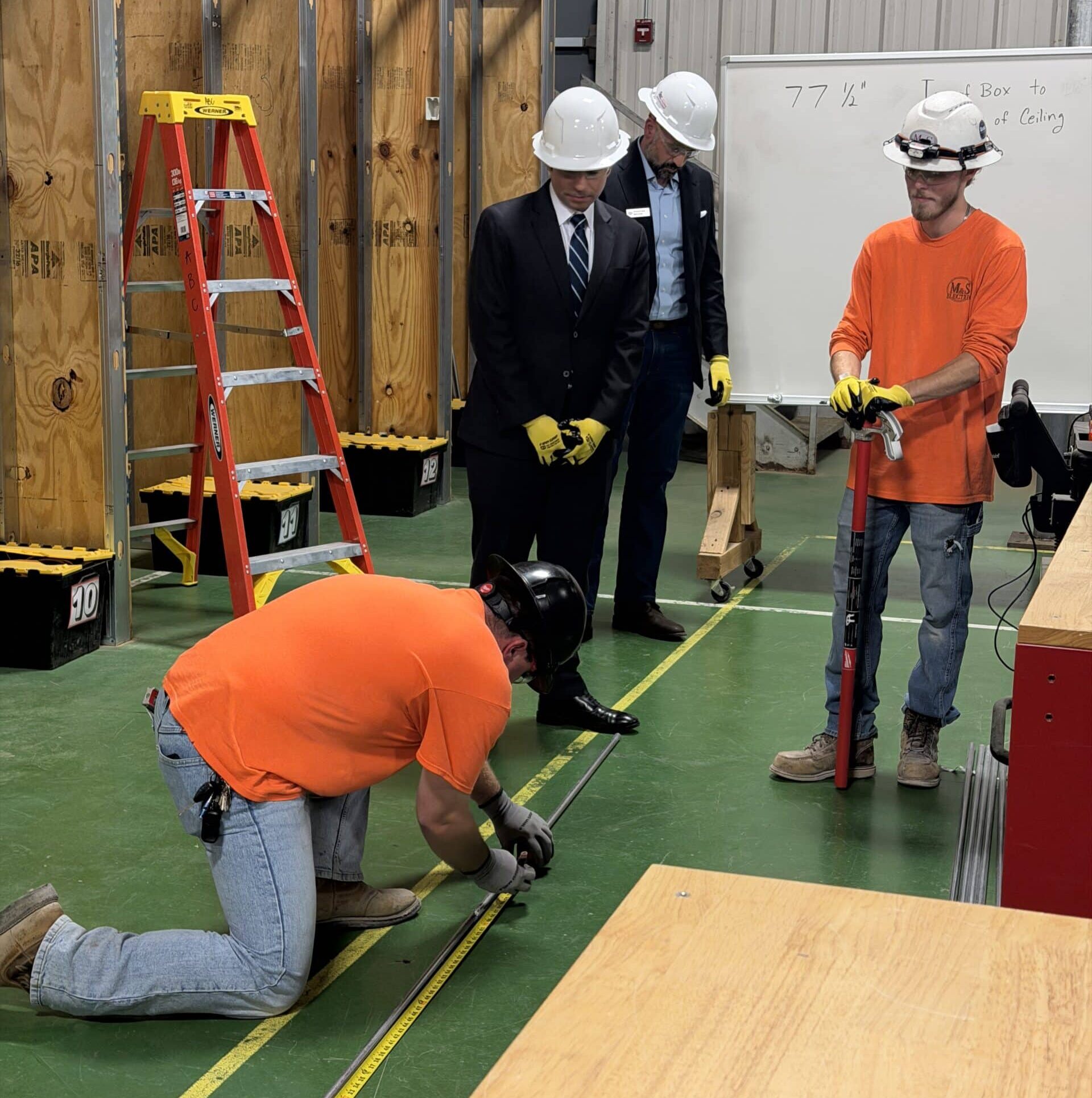
ABC Heart of America was proud to welcome U.S. Secretary of Labor Keith E. Sonderling…
What’s on the Horizon for Contractors, and How to Control What Happens Next

Most of the contractors I talk with are watching the same three things: labor, backlog, and financing. Fair enough. Those have been the scoreboard for this industry for as long as anyone can remember. But there’s a fourth thing worth watching, and it doesn’t show up on a job-cost report. It’s the question of who is going to own and run these companies five years from now.
That question is closer to the surface than most owners realize, and here is why it deserves your attention now. Of all the big variables in your business, it is one of the very few you can still decide for yourself. You don’t control the labor market. You don’t control interest rates, or what a buyer is willing to pay next spring, or when your best superintendent decides to start his own shop. You do control whether ownership of your company changes hands on your terms or on someone else’s. Three shifts happening in construction right now are quietly shortening the window on that decision, and each one changes what “being ready” actually means for a contractor.
The Labor Gap Is Becoming an Ownership Gap
Associated Builders and Contractors projects the industry needs to attract roughly 349,000 new workers in 2026. That’s down from the 439,000 ABC projected for 2025, but the reason it’s down should give every owner pause. Anirban Basu, ABC’s chief economist, has been direct about it: the majority of new worker demand in 2026 is attributable to retirement rather than to increased demand for construction services. Spending is expected to pick back up in 2027, pushing the number toward 456,000. Gen Z is showing more interest in the trades than the headlines suggest, which is genuinely good news. But that pipeline takes years to fill, and it isn’t filling fast enough to offset who’s leaving.
Here’s the part that doesn’t make it into the workforce reports: the people retiring aren’t only running crews and reading plans. Many of them are running companies. The same generation that built the estimating department, holds the bonding relationship, and signs the personal indemnity agreement is the generation the labor statistics are describing. The industry-wide labor shortage and the individual owner’s succession question are, more often than people realize, the same story told at two different scales.
I’ve sat across the table from more than one owner in his sixties who told me, half-joking, that he’ll retire when his body gives out. His body is not a succession plan. Neither is the vague understanding that “Tommy will probably take over” if Tommy has never seen a P&L, doesn’t know what the bonding line will require of him, and has never had that conversation in anything but hallway shorthand. Those aren’t plans. They’re defaults. And a default is simply a decision you’ve handed to circumstance, to be made on a day you didn’t pick.
Outside Money Has Found Construction
The second shift is who wants to buy what you’ve built. Private equity has become a serious, sustained presence in construction, especially in the specialty trades, pursuing platform investments and add-on acquisitions up and down the value chain and paying real money to do it. Firms with exposure to data centers and power infrastructure are commanding premium valuations right now, driven by AI and electrification demand. Capstone Partners, reviewing construction services transactions from 2018 through 2025, found that private equity buyers paid an average of about 10.6x EBITDA over that period, compared with roughly 7.5x for strategic buyers. Those are averages across many deals, not a number anyone is promising you. What your company commands depends almost entirely on what a diligence team finds when it opens your books.
And that’s the part worth sitting with. Buyers aren’t just looking at backlog and a strong balance sheet anymore. They want clean, defensible job costing. They want backlog they can see and trust. They want documented safety records and a leadership bench that isn’t three deep at the very top and empty underneath. A company can be genuinely excellent, well run, profitable, and respected in its market, and still not be buyer-ready, simply because none of that excellence has been written down in a form a buyer’s diligence team can verify.
More buyers at the table is leverage. But it’s leverage only for the owner who can prove what he’s selling. Everyone else at that table is a price-taker, accepting the story the buyer tells about the business rather than telling it himself.
The Deal Math Changed Under Everyone’s Feet
The third shift is quieter but just as real. Recent federal tax changes have meaningfully altered the economics of a transaction. The structure that made sense for a colleague’s exit two or three years ago isn’t automatically the structure that makes sense today. Entity type, timing, and how a deal is built between an asset sale and a stock sale all interact differently with the tax code than they did before.
None of this means you need to sell tomorrow. It means the planning window matters more than it used to, and owners who wait until a buyer calls are planning under someone else’s clock instead of their own. I’ve watched that difference play out more than once. The owner who started the conversation two years early ends up choosing among options. The owner who started it the week the offer letter arrived ends up negotiating against himself and his own timeline. I have stories to share that support both realities.
What This Adds Up To
Put those three shifts together and they point at the same conclusion from three different directions. The workforce that’s retiring includes owners, the so-called silver tsunami. The buyers circling the industry expect more evidence than most companies have on paper. And the deal structure that protects you has changed since the last time anyone you know actually sold a company. Readiness isn’t a someday project anymore.
It’s a live variable, and it’s the one on this list that stays under your control, right up until the moment it doesn’t.
Who You’d Be Working With, and Why It’s Built This Way
This is where Montage Legacy fits in, and I want to be specific about how, because the how is different from what you’ll get at any single professional firm. Most advisors see one slice of your picture. We built this practice so that somebody is finally looking at the whole thing, and so that the decisions coming out of it are yours.
My partner Stuart Sorkin and I are former attorneys, and because we no longer act as legal counsel, we’re free to do something a lawyer can’t: sit at the same table, in the same conversation, with everyone who has a stake in your transition. Your family. Your CPA. Your attorney. Your bonding agent. Your investment advisor. The superintendent or project manager you’ve been quietly grooming, or the private equity group that’s already called. In construction specifically, that matters more than most industries realize, because your bonding capacity is often tied to your personal indemnity, and it does not transfer to a new owner cleanly or automatically. That’s exactly the kind of detail that falls through the cracks when your advisors are each working from a different piece of the picture instead of the whole one.
Leo Manzione, another partner brings extensive coaching and business growth experience to the table of over 12 years to all types of businesses, most notably including construction. Leo is currently working with two contractors with readiness assessments, escalating the value of the company while working with the potential successors, along with me.
Kelli Watson, Business and Transition Coach at Montage Legacy, brings more than two decades of experience coaching leaders and business owners through growth, transition, and succession, work she’s built through her role as Director of Coaching at Todd Durkin Enterprises and as co-author of Exit by Design. Kelli handles the conversations that get skipped: the family and stakeholder discussions, the documentation of a plan that’s lived only in an owner’s head, and the coordination that keeps everyone at the table on the same page. When a family has more than one child working in the business, or a succession plan exists only in hallway shorthand, Kelli is the reason that conversation ends in a decision instead of an argument.
Among the four of us, what we do is straightforward: entity and ownership structure review, so your company is clean and legible to a buyer or a successor. Documentation of the plan you already carry in your head, so it survives contact with a diligence team, a family conversation, or your own two weeks out of the office. Tax-aware strategy that reflects the current rules, not the ones that were true when your neighbor sold his shop. And an honest, unhurried look at what buyer-ready would require for your company specifically, whether the buyer turns out to be a stranger, a private equity platform, or the person already running your second-biggest job.
Not legal advice. Not financial advice. Just the strategic documentation, guidance, and business lens a contractor needs to prepare wisely, while there’s still time to do it on your own schedule instead of someone else’s.
Control Is Something You Decide Early or Not at All
You don’t have to have an exit date in mind to start this. Most of the owners we work with don’t. What they do have is a sense that the ground has shifted, that the industry around them is consolidating, retiring, and re-pricing faster than their own plans have kept up with, and a wish that someone would get the whole table talking before a deadline forces it.
Every one of these transitions gets decided by somebody. Start early and it’s you, setting the timing, the successor, the structure, and the price you’re willing to accept. Wait, and it gets decided anyway, by a buyer working his own clock, a lender protecting his own position, or a health event that arrives without warning. Possibly by someone you have never met.
If that sounds like where your company is right now, I’d welcome the conversation. You can book a consultation call, and we’ll talk through what getting ready would look like for you.
David C. Seitter
DS Strategies & Consulting
Business Transition Advisor
Related Posts